



Money Clarity COmmunity
You're Not Bad with Money. You Just Don't Know Your Financial Attachment Style.
Join the only community that understands your Financial Attachment Style.
This Isn't Another Budgeting Course
This is a community of people who finally "get it" about money psychology.
Here's what every financial program gets wrong: They assume everyone thinks about money the same way. They give you spreadsheets. Complicated systems. One-size-fits-all advice. Then you feel like a failure when it doesn't work.
The truth? Some people feel loved through financial security. Others through shared experiences. Some through generous giving.
In Money Clarity Community, you'll discover YOUR Financial Attachment Style and connect with others who understand exactly how your mind works with money.
What If Money Conversations Actually Brought You Closer?
Inside Money Clarity Community, you'll discover whether you're a:
Security Saver
You feel safe through savings and planning
Experience Creator
You connect through shared experiences
Gift Giver
You show love through generous giving
Practical Provider
You express care by handling logistics
Freedom Facilitator
You value independence and autonomy
Once you know YOUR style (and your partner's), everything clicks.
Here's Exactly What You Get in the Community
Learn your Financial Attachment Style in under 10 minutes
Get word-for-word scripts for money conversations that actually work
Live monthly masterclass where you can ask Kris your specific questions
Private community where people actually understand your money struggles
Monthly challenges designed for your specific attachment style
24/7 access to all resources and replay recordings
No spreadsheets. No complicated systems. Just understand your psychology and connect with people who think like you.


Start Your Community Membership

Sign Up Below to Join for FREE!
We respect your privacy and will never share your information. Unsubscribe anytime.


Frequently Asked Questions
What makes this different from other financial communities?
We start with emotional intelligence, not spreadsheets. While other programs focus on budgeting tactics, we address the root cause of money struggles: your emotional relationship with money and your Financial Attachment Style.
Do I need to be married or in a relationship to join?
Not at all! While we have content specifically for couples, our emotional intelligence approach works for anyone who wants to transform their relationship with money. Singles, couples, families, teens, entrepreneurs - everyone benefits from understanding their Financial Attachment Style.
What if I'm terrible with money or have money shame?
You're exactly who we're here to serve! Money shame and feeling "bad with money" are emotional patterns we specialize in healing. This community is a safe space to work through these feelings with others who understand.
How much time do I need to invest each month?
The monthly masterclass is about 60 minutes, Q&A sessions are 45 minutes, and challenges are designed to take just a few minutes daily. You can engage as much or as little as fits your schedule.
As Seen In The Press
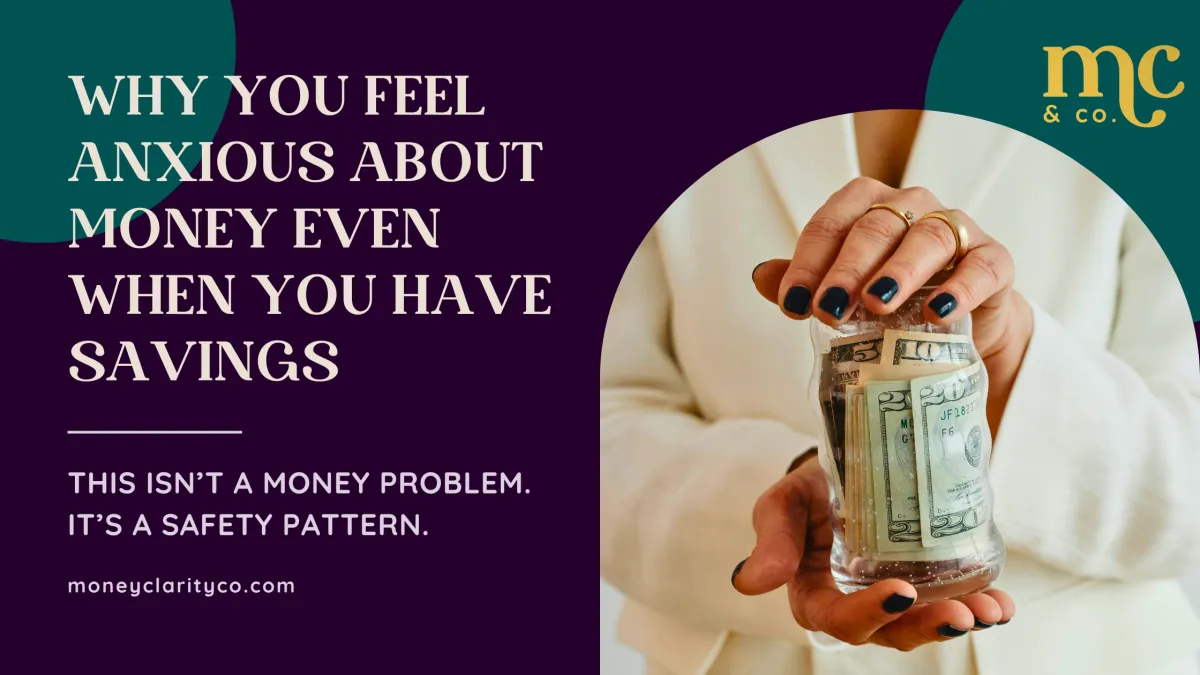
Why You Feel Anxious About Money Even When You Have Savings
Let me guess what's in your bank account right now.
Six months of expenses. Maybe more. Multiple savings accounts with specific labels. An emergency fund that could handle an actual apocalypse. You've done everything the financial experts told you to do.
And you still can't relax about money.
You check your balance multiple times a day. You stress about "unnecessary" spending even when you can absolutely afford it. You saved for the vacation and now you're anxious about every meal out. The number in your account grows, the knot in your stomach doesn't budge.
Welcome to the Security Saver paradox: No amount of money in the bank makes the anxiety go away because the problem was never actually about the money.
What It Means to Be a Security Saver
If you're a Security Saver, financial stability isn't just a nice bonus. It's oxygen.
Every dollar saved whispers "you're going to be okay." Every emergency fund contribution feels like building a fortress against chaos. You make financial decisions based on worst-case scenarios because somewhere along the way, you learned that safety isn't guaranteed.
For you, money equals safety equals love equals control.
When you have money saved, you can breathe (sort of). When the balance drops, your nervous system activates every alarm it has. This isn't about being "cheap" or "overly cautious." This is your brain trying to keep you safe the only way it knows how.
How You Became a Security Saver
Here's the uncomfortable truth: You didn't wake up one day and decide to be hypervigilant about money.
Something taught you that financial instability equals danger.
Maybe you watched your parents stress about bills. Maybe you experienced actual financial hardship. Maybe there was plenty of money with zero emotional security, so you learned to control what you could.
Maybe it was just one comment. One moment when money felt scary and unpredictable. Your young brain absorbed the lesson: Financial security is the only security you can count on.
Your Security Saver pattern made perfect sense at the time. It probably saved you. Here's the thing about survival strategies: They don't automatically update when the danger passes.
So now you're an adult with a stable income, healthy savings, and you still feel like you're one bad decision away from disaster. Your nervous system is still running on outdated threat information.
Why Your Anxiety Isn't About the Numbers
You could have a million dollars in savings and you'd still find something to worry about.
Because the anxiety isn't coming from your bank balance. It's coming from what your nervous system learned about safety a long time ago.
Your brain categorized "not having enough money" as a survival threat. The same way it would categorize a physical danger. Once something gets coded as a threat, your nervous system stays vigilant.
Here's what makes this particularly exhausting: Your nervous system doesn't know the difference between "I don't have money for rent" and "I have six months of expenses saved with a 'what if something terrible happens' thought loop."
To your body, both scenarios feel like danger. Both trigger the same stress response. Both demand the same hypervigilance.
So you're not being irrational when you feel anxious despite having savings. Your nervous system is doing exactly what it was trained to do. It's just doing it based on information that's no longer accurate.
The Hidden Cost of Constant Control
The control that makes you feel safe is also keeping you stuck.
You won't take the career opportunity because it feels risky. You won't enjoy spending money on experiences because "what if we need it later?" You say no to things that would bring you joy because the price tag triggers your safety alarm.
Your partner (if you have one) probably feels the pressure too. Every financial conversation becomes about worst-case scenarios. Every purchase gets scrutinized. Every plan gets filtered through "can we really afford this?" even when the answer is obviously yes.
The security you're creating for yourself can feel like control to everyone around you.
And the worst part? Deep down, you know this isn't really about the money. You know the anxiety would follow you even if you won the lottery. Because the problem isn't the bank balance. It's what your nervous system learned about safety back when you were too young to question it.
What Security Saver Anxiety Actually Looks Like
You check your bank account multiple times a day. Not because anything changed. Because your nervous system needs reassurance.
You can't enjoy the money you have. You saved for the vacation and stress about every dinner out. You built the emergency fund and you're too anxious to use it for actual emergencies that aren't apocalyptic.
You catastrophize about money constantly. Every expense triggers a mental spiral about worst-case scenarios. Your brain generates disaster movies on repeat.
You feel guilty about any "unnecessary" spending. That latte isn't just coffee, it's evidence that you're being irresponsible. Treating yourself feels morally wrong.
You research purchases to death. You spend hours comparing prices, reading reviews, calculating whether you really need something. The mental energy you expend avoiding a "wrong" purchase is exhausting.
You can't celebrate financial wins. You got a raise? Great, now you need to save more. You paid off debt? Cool, what's the next thing to worry about? There's no finish line where you get to relax.
Sound familiar? Yeah. I thought so.
Why Traditional Financial Advice Fails Security Savers
Most financial advice for anxiety says things like "just relax about money" or "learn to enjoy spending guilt-free."
That's like telling someone with anxiety to just calm down. Adorable. Useless.
Here's what actually works:
1. Scheduled Money Check-Ins
The Problem: You check your bank account constantly, which reinforces the anxiety loop. Every check temporarily soothes your nervous system, then the anxiety builds again until you need another hit of reassurance.
The Solution: Schedule specific times to review your finances. Once a week. Same day, same time. Your brain gets the control it needs without the constant vigilance.
What this looks like: Sunday mornings, you spend 20 minutes reviewing accounts, paying bills, updating your tracking system. The rest of the week? You're off duty. When the urge to check hits, remind yourself: "I have a scheduled time for this. I'm not ignoring it, I'm managing it."
Your anxiety will protest at first. That's normal. You're teaching your nervous system a new pattern.
2. Ground Your Nervous System Before Financial Decisions
The Problem: You make financial decisions from a triggered state. Fear is driving the car.
The Solution: Ground your nervous system BEFORE opening your banking app or making money decisions.
What this looks like:
Take three deep breaths (seriously, do it)
Notice where you feel tension in your body
Ask yourself: "Am I in actual danger right now or does this just feel dangerous?"
Only then make the decision
When you're making choices from a calm nervous system instead of a triggered one, you make better decisions. You can tell the difference between real risk and anxiety-brain generating fictional disasters.
3. Create a Safety-to-Spending Ratio
The Problem: You feel guilty spending money even when you can afford it because your nervous system can't distinguish between necessary safety and excessive control.
The Solution: Create a clear formula that honors your need for security while giving you permission to enjoy your money.
What this looks like:
Decide your non-negotiable safety number (three months of expenses? six months? you decide based on what actually helps you sleep at night)
Once you hit that number, give yourself explicit permission to spend on joy without guilt
When the balance dips below your safety number, return to fortress mode
Repeat
This creates a boundary that your nervous system can trust. "We have our safety number. This spending is allowed. We're not in danger."
4. Separate "Safety Money" from "Life Money"
The Problem: When all your money feels like safety money, you can't enjoy any of it. Every dollar feels like it belongs in the fortress.
The Solution: Literally separate accounts. Safety money lives in one account (don't touch it). Life money lives in another (you're allowed to spend this).
What this looks like:
Emergency fund = Safety Money (untouchable except for actual emergencies, which you define clearly)
Checking account + fun money account = Life Money (you can use this guilt-free)
Your brain can relax about Life Money because Safety Money is protected
Physical separation helps your nervous system understand: "This money is for security. That money is for living. I don't have to choose between them."
5. Reality-Check Your Catastrophic Thinking
The Problem: Your brain generates worst-case scenarios that feel completely real and probably aren't.
The Solution: When anxiety hits, write down the catastrophic scenario. Then write down how you'd actually handle it. Usually, you'll realize you'd figure it out.
What this looks like:
Anxiety: "What if I lose my job?"
Reality check: "I have six months of expenses saved. I have skills people pay for. I have a network. I'd update my resume, reach out to contacts, probably find something within three months. Even if it took longer, I'd be okay."
Result: Your nervous system realizes you're more prepared than it thought
This isn't toxic positivity. This is showing your brain evidence that contradicts its disaster predictions.
The Part Nobody Tells Security Savers
You don't have to choose between feeling safe and enjoying your life. You need both.
Your need for financial security is valid. You're not "too anxious." You're not "too controlling." You learned to protect yourself in a world that felt unsafe. That makes sense.
You also deserve to enjoy the safety you've created. You deserve to spend money on things that bring you joy without the guilt spiral afterward. You deserve to take calculated risks without your nervous system staging a full revolt.
The bridge between safety and freedom is awareness.
When you understand that your Security Saver pattern is a nervous system response (not a character flaw), you can work with it instead of fighting it. You can build the safety you need while also giving yourself permission to actually live.
What Healing Looks Like for Security Savers
You'll know you're making progress when:
You can look at your bank account without your heart racing. You make financial decisions from clarity instead of fear. You spend money on experiences without the three-day guilt hangover.
You can sit with uncertainty without needing to control everything. You trust yourself to handle whatever comes without having to predict and prepare for every possible disaster.
This doesn't mean you stop saving or being responsible. It means you stop letting fear run your financial life.
It means you can finally use the emergency fund for an actual emergency without the anxiety attack. You can book the trip without checking your balance seventeen times first. You can buy the thing you want without the mental gymnastics of justifying it.
You can breathe.
Your Next Step
If this hit a little too close to home (Security Savers, I see you mentally calculating your emergency fund balance right now), here's what to do:
Join the Money Clarity Community
Connect with other Security Savers who are learning to feel safe without staying stuck. Inside the community, you'll get:
The full Security Saver Deep Dive replay with nervous system practices and money management strategies
Ongoing support from people who understand the anxiety loop
Practical tools for managing your Security Saver patterns
Monthly workshops on working WITH your Financial Attachment Style
Join the Money Clarity Community →
Because honestly? You've worked so hard to create financial security. You deserve to actually enjoy it.
Your safety isn't dependent on perfect control. It's already here. You just need to teach your nervous system to believe it.

Ready to Master Your Money Emotions?
Join people who are transforming their relationship with money from the inside out.
Questions? Email us at [email protected]